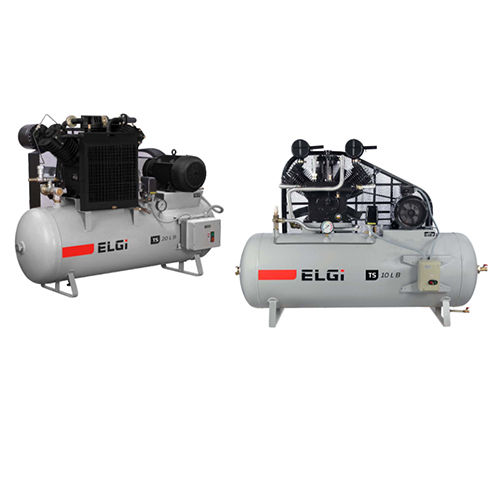
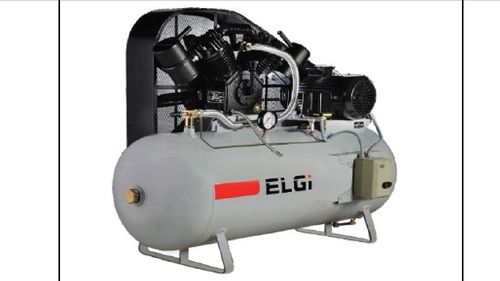
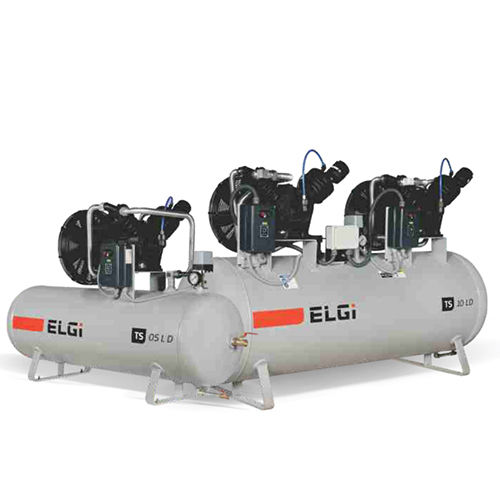
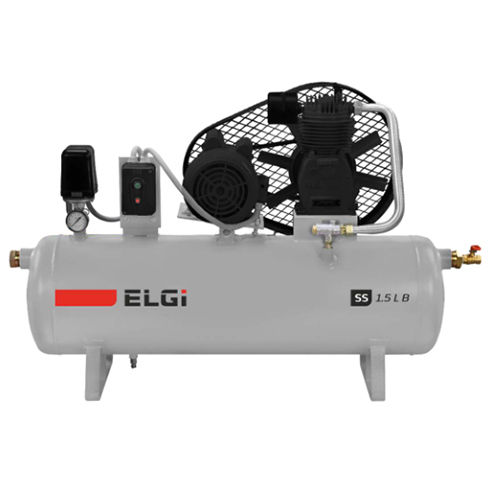
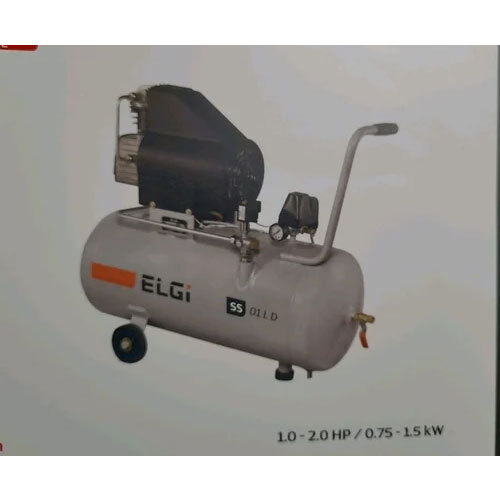
About Single-and Two Stage Compressors
Specification
|
Air Receiver
|
160 Liters
|
|
Compressor
|
550 RPM
|
|
Motor Power
|
3 to 40 HP,2.2 kW
|
|
No of Cylinder
|
2
|
|
Overall Dimension
|
1345 x 540 x 1085 mm ( L x B x H )
|
|
Free Air Delivery
|
256 M2/hr,9 cfm
|
|
Piston Displacement
|
360 lpm,12.7 cfm
|
|
Net Weight
|
205 kg
|
Technical Details 
Efficiency and PerformanceDesigned for demanding environments, these compressors utilize high-quality cast iron cylinders and MS frames, ensuring durability and consistent output. The belt-driven mechanism and air-cooled system guarantee optimal functioning even under continuous usage, with noise levels above 70 dB.
Versatile ApplicationsFrom automotive workshops to large-scale industrial facilities, our compressors adapt seamlessly thanks to customizable tank capacities, mounting options, and operational parameters. The splash lubrication system further enhances longevity, reducing maintenance frequency for busy users.
FAQ's of Single-and Two Stage Compressors:
Q: How do single-stage and two-stage compressors differ in operation?
A: Single-stage compressors compress air in one step, suitable for moderate pressure needs, while two-stage compressors compress air twice for higher pressures, ideal for demanding industrial and workshop applications.
Q: What is the ideal application and usage for these compressors?
A: These compressors are designed for industrial, workshop, factory, and automotive tasks, such as powering pneumatic tools, spray painting, and general equipment operation requiring consistent airflow between 7 and 35 CFM.
Q: When should I choose a tank-mounted versus a base-mounted compressor?
A: Tank-mounted compressors are preferred when space is limited and portability is required, whereas base-mounted units are best for fixed installations where higher capacity and stability are necessary.
Q: Where can I install these compressors?
A: They can be installed in workshops, factories, industrial plants, and automotive service centers. Select a well-ventilated location with access to a suitable electrical supply (220 V/415 V) for optimal performance.
Q: What is the process for starting and controlling these compressors?
A: You can start the compressor using either a DOL (Direct-On-Line) or Star Delta starter, depending on motor rating. An optional control panel allows advanced monitoring and precise operation control.
Q: How does splash lubrication benefit the compressor?
A: Splash lubrication efficiently maintains cylinder and piston function, minimizing friction and wear, resulting in a longer service life and reduced maintenance needs.
Q: What are the main benefits of using a reciprocating air compressor with belt-driven technology?
A: Belt-driven reciprocating air compressors offer quieter operation, easier maintenance, and efficient performance, making them well-suited for varied industrial and workshop environments.